What to Do After 10th: Streams, Courses and Career Options
Compare Science, Commerce, Humanities, diploma, Polytechnic, ITI and vocational routes—and use a practical five-step framework to make an informed choice.
By INVIKTUS Career Guidance Team
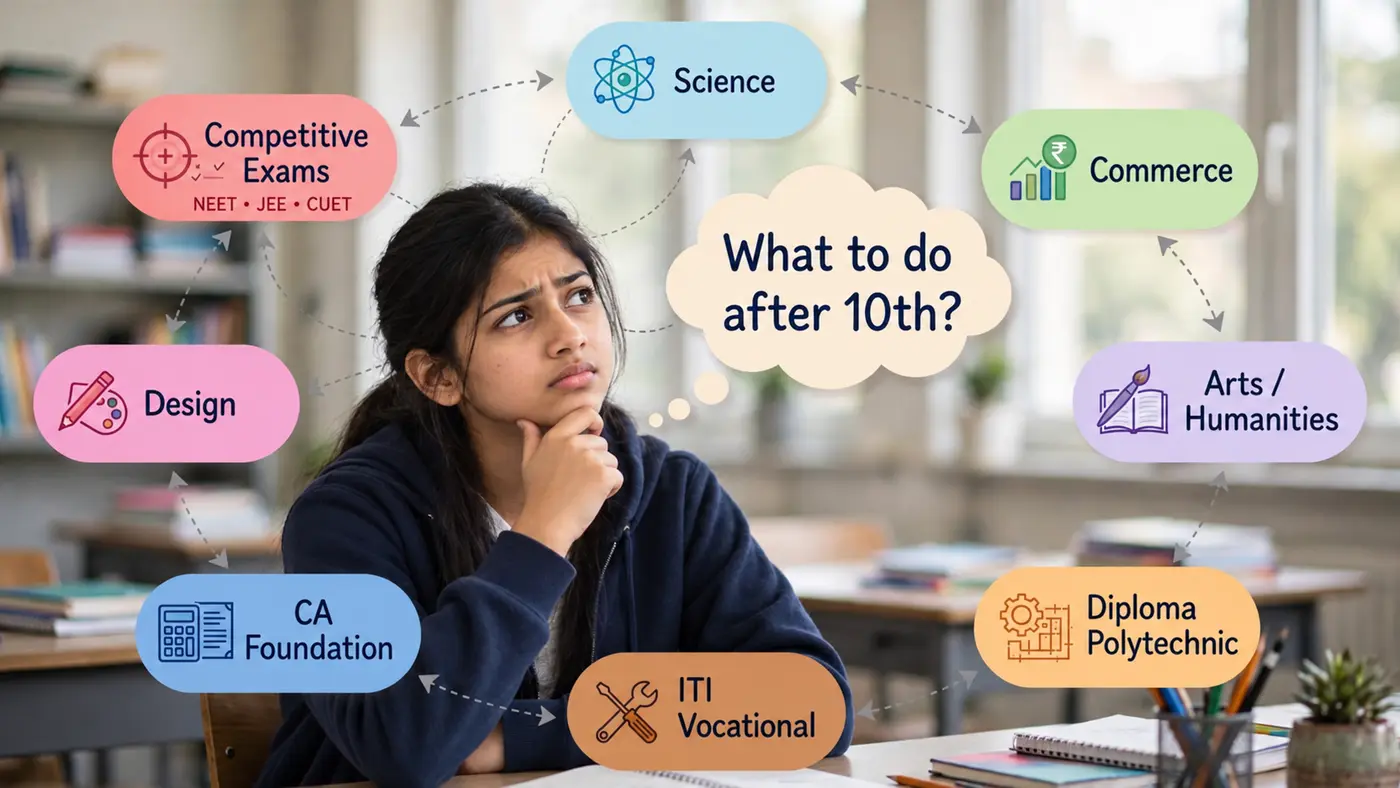
Completing Class 10 opens several possible routes: senior secondary education, a diploma, ITI or other skill-based programmes. The aim is not to identify one universally best option. It is to choose a route that fits the student's interests, aptitudes, preferred way of learning and longer-term goals.
This choice matters, but it does not permanently lock a student into one career. Many higher-education and employment pathways allow students to build new skills, change specialisations or combine subjects later. A thoughtful decision now simply provides a stronger and more motivating starting point.
Understand the main pathways
Science
Science may suit students who enjoy understanding how things work, solving quantitative problems, conducting experiments or studying living systems. Subject combinations differ across boards and schools, but commonly include Physics and Chemistry with Mathematics, Biology or both, along with languages and electives.
Possible directions: engineering, architecture, medicine and allied health, pharmacy, life sciences, research, computing, data and selected design or defence pathways. Admission requirements vary by course and institution.
Commerce and Business Studies
Commerce may suit students interested in business, money, markets, organisations, entrepreneurship and analytical decision-making. Common subjects include Accountancy, Business Studies and Economics, with Mathematics, Applied Mathematics or Informatics Practices depending on the school.
Possible directions: chartered accountancy, company secretaryship, finance, banking, economics, business analytics, management, marketing, taxation, fintech and entrepreneurship.
Humanities and Social Sciences
Humanities may suit students who enjoy people, society, communication, languages, history, public affairs, creativity and critical thinking. Schools may offer subjects such as History, Political Science, Geography, Psychology, Sociology, Economics, Legal Studies, Fine Arts and languages in different combinations.
Possible directions: law, psychology, public policy, civil services, journalism, social sciences, design, communication, education, social work, media and hospitality.
Diploma and Polytechnic programmes
Diploma and Polytechnic programmes offer structured technical and applied learning after Class 10. Options may include engineering disciplines, computer applications, design, hospitality and other specialised fields. Some diploma holders may later be eligible for lateral entry into a related degree; always verify current institutional and state rules.
ITI and vocational programmes
Industrial Training Institutes and recognised vocational programmes focus on practical occupational skills. Trades can include electrician, electronics mechanic, fitter, draughtsman, computer operator, refrigeration and air-conditioning, fashion technology and others. These routes can lead to apprenticeships, employment, self-employment or further technical study.
Compare the pathways
| Pathway | A good fit when a student enjoys | Learning emphasis | Typical next steps |
|---|---|---|---|
| Science | Experiments, mathematics, technology or living systems | Concepts, analysis, laboratories and problem-solving | Degree programmes, entrance examinations or specialised training |
| Commerce | Business, numbers, economics, markets or entrepreneurship | Accounting, economics, business and analytical skills | Professional courses, business degrees or entrepreneurship |
| Humanities | Society, people, language, creativity or public affairs | Research, writing, interpretation and critical thinking | Arts, law, social sciences, design, media or public service |
| Diploma | Applied technical work and structured practical learning | Technical theory, laboratories and workshops | Employment, apprenticeship or eligible lateral-entry routes |
| ITI / Vocational | Hands-on occupational skills and early workplace exposure | Trade practice, tools, safety and employability | Apprenticeship, employment, self-employment or further training |
The INVIKTUS five-step decision framework
- 1Understand interests and aptitude. Look beyond marks. Consider the subjects, activities and problems the student genuinely enjoys, together with aptitude and work preferences.
- 2Explore more than familiar careers. Compare multiple occupations, the work they involve, required qualifications, working conditions and realistic entry routes.
- 3Check subject and admission requirements. Review the eligibility rules for courses and entrance examinations that may matter later. Requirements can differ and may change.
- 4Discuss the evidence. Parents, teachers and career counsellors can contribute different observations. A good decision combines student preference with evidence—not pressure or imitation.
- 5Experience the options. Review syllabi, sample lessons, project work and conversations with current students or professionals before committing where possible.
A free first step
Discover what naturally interests you
Use the free INVIKTUS Interest Explorer to organise your thoughts before discussing streams and careers with parents, teachers or a counsellor.
Explore My InterestsCommon mistakes to avoid
- Choosing mainly because friends selected it
- Treating Science as the only prestigious option
- Assuming Commerce is only for students who dislike Science
- Assuming Humanities has limited career scope
- Ignoring diploma, ITI and vocational routes
- Choosing only from marks without considering motivation
- Relying on outdated course or entrance requirements
Frequently asked questions
Which is the best stream after Class 10?+
There is no single best stream. The most suitable choice depends on the student’s interests, aptitude, subject preferences and intended pathways.
Can a student change career direction later?+
Yes. Many careers accept students from different academic backgrounds, although some professional courses require specific subjects. Check eligibility before selecting subjects.
Is Mathematics compulsory for Commerce?+
Not in every school or programme. However, Mathematics or Applied Mathematics can be useful or required for some economics, finance, analytics and higher-education pathways.
Can students begin CA preparation after Class 10?+
ICAI permits provisional registration in the Foundation course after Class 10. Students must still meet the applicable Class 12 and study-period requirements before appearing for the examination.
Is a diploma always followed by direct second-year BTech admission?+
No. Lateral-entry eligibility depends on the diploma discipline, marks, institution, university and current state or regulatory rules.
When should a student seek career guidance?+
Career guidance is useful before subject selection when the student is uncertain, has conflicting interests or needs help comparing education and career routes.
Make an informed choice
A stream is a starting point, not a measure of intelligence or future success. The strongest choice is one the student understands, is motivated to pursue and can connect to realistic next steps. INVIKTUS combines structured career exploration, psychometric assessment and professional counselling to help families decide with greater clarity and confidence.